
Standing Meeting – IT & Automation | Friday, September 26 2026.

1. Why do AI and Automation matter?
IT opened with a few figures from recent studies (2025-2026):
- 5.4%: according to the Fed St. Louis (2025), AI saves 5.4% of work hours per week, about 2.2 hours.
- 3.6 hours/week: according to Dillon et al. (2025), time spent handling email drops by 3.6 hours a week (about 31%).
- 29.4%: according to Metrigy (2025-2026), productivity rises by 29.4%, equal to about 11.8 hours freed up per week.
These studies measured different groups, so the numbers vary quite a bit, but they all point the same way: AI and Automation significantly cut the time we spend on repetitive work. The message of this section: Automation replaces repetitive tasks, not people.
2. AI and Automation for both Tech and Non-tech teams
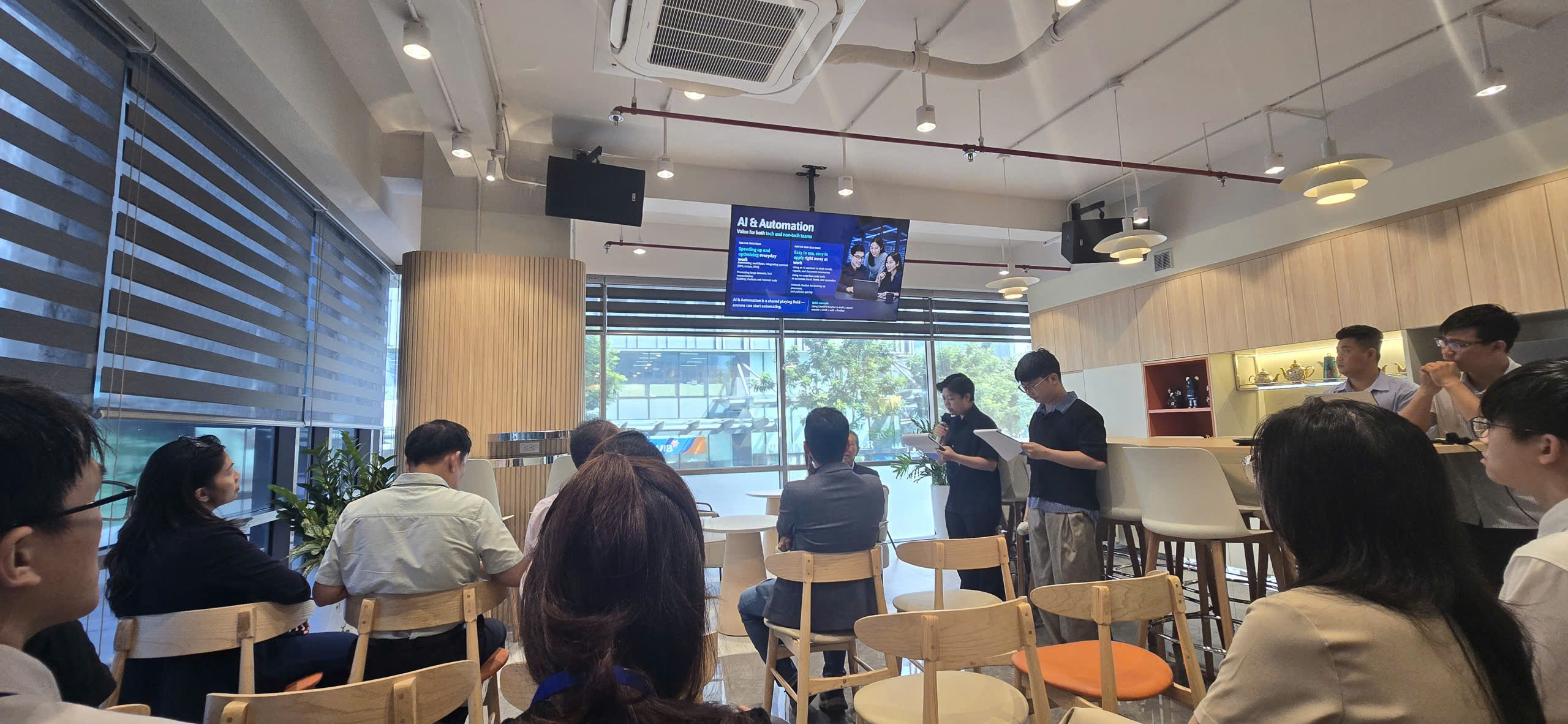
The second slide stressed that AI is a “shared playing field” where anyone can start.
For the Tech team: AI and Automation speed up and optimize everyday work, for example:
- Automating workflows and integrating systems (RPA, scripts, APIs).
- Processing large datasets and fast reconciliation.
- Building chatbots and internal tools.
For the Non-tech team: easy to use and easy to apply right away, for example:
- Using an AI assistant to draft emails, reports, and document summaries.
- Using no-code/low-code tools to automate Excel, forms, and reminders.
- Using an internal chatbot to quickly look up processes and policies.
Quick example: using ChatGPT or Copilot to draft a report in 4 steps: request → draft → edit → finalize. AI handles the first draft, and you handle the checking and the final decision.
3. Time saved: what is it used for?
This was the part I found most worth thinking about. The slide suggested three ways to reinvest the time you save:
- Deeper analysis: interpreting data and spotting issues.
- Learning and improving: picking up new AI tools and automating even more.
- Supporting teammates: sharing more effective ways of working.
It also cited a survey by Stanford, George Mason, and Clemson (6/2025): processing time per task drops from 90 minutes to 30 minutes, at least 1 hour is saved per task, and productivity can increase up to 3x across many tasks.
4. A view from China: AI in everyday life
CM’s sharing showed that in China, AI is no longer a distant technology but part of daily habits. Some common examples:
- QR code payments almost everywhere, from restaurants to street stalls.
- Food ordering, delivery, and ride-hailing apps that use AI to optimize routes and timing.
- Robots and automated systems in restaurants, hotels, and warehouses.
- AI assistants built into familiar apps, so users ask and get answers right away.
What’s worth learning is not the specific technology but the mindset: they use AI where it makes life faster and more convenient, and ordinary users can use it right away without understanding the technical side.
5. Conclusion
The meeting closed with a clear message: Automation doesn’t take work away. It gives time back so people can reduce repetitive work.
The accompanying direction: don’t just automate to save time, but use that time to create new value.
So after the meeting, here is a small thing each of us can try:
- Pick one repetitive task you do every week (drafting emails, compiling reports, data entry…).
- Ask AI or an automation tool to help with it.
- Always read and edit the result before using it.
- Use the time you save to learn more, analyze more deeply, or help a teammate.
The meeting ended with the IMV slogan.
Comments (0)
Newest